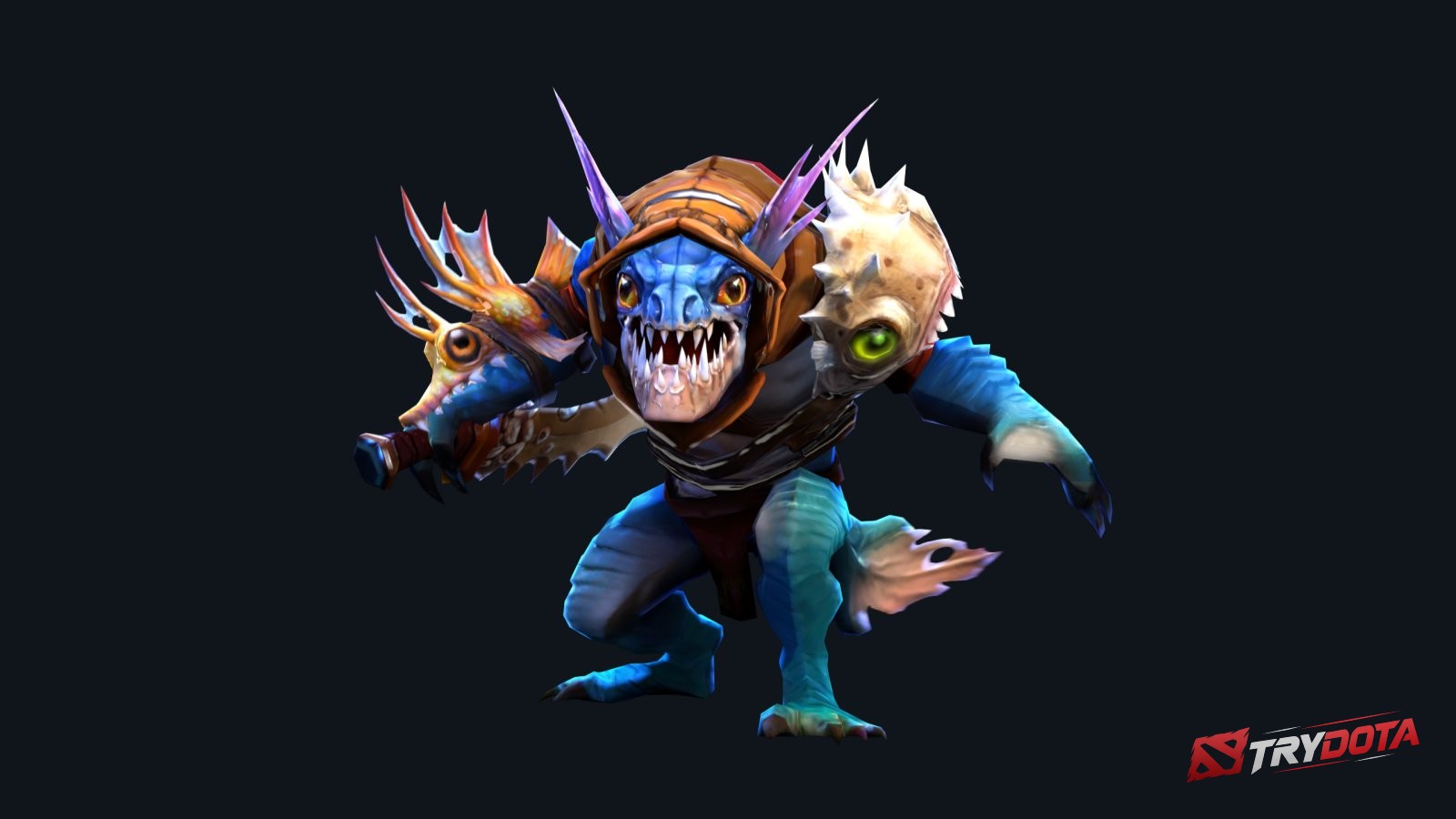
Hi! Today I’m looking at Slark in the context of 7.41f, and the first thing that stands out is this: the hero still lives off tempo, stealth, and the ability to survive until his power window opens. He’s an agility melee carry with a clearly defined escape profile, and his kit is still all about jumping in, grabbing a target, and not staying put any longer than necessary.
Role and abilities
By feel, Slark remains a hero who likes trades on his own terms. It’s important for him not just to start a fight, but to stay in it long enough to steal resources and get out alive. He has a difficulty rating of 2 out of 3, and that feels right: the kit looks straightforward on paper, but it demands careful timing.
- Dark Pact — removes most negative effects from the hero and deals damage to nearby enemies.
- Pounce — a leap forward that latches onto the first hero in its path; with Aghanim’s Scepter, it grants charges and increases leap range.
- Saltwater Shiv — cuts the target and steals its movement speed, health regen, and HP restoration; effects from multiple casts stack and are tracked separately.
- Depth Shroud — an Aghanim’s Shard ability that creates a cloud which conceals allies and gives them Shadow Dance.
- Essence Shift — innate ability.
- Shadow Dance — grants passive movement speed and health regeneration when enemies cannot see the hero; the active portion hides him in a shadow cloud that cannot be revealed and is not removed by the hero’s actions.
What I find especially interesting is this whole stealth-and-sustained-pressure package. Slark doesn’t look like a hero who has to end things in the first few minutes, and that’s always a plus in my book: he shines when the game lets him build momentum and carefully turn every good move into an advantage.
Changes in the latest patches
If you go from the newest to the older changes, 7.41f has no notable Slark adjustments in the data, and the overall picture is formed by the updates that came earlier in the 7.41 cycle.
- 7.41d: Saltwater Shiv cooldown reduced.
- 7.41b: Essence Shift duration reduced; the level 20 talent had its Essence Shift duration bonus lowered.
- 7.41a: Shadow Dance bonus movement speed reduced; the level 20 and 25 talents swapped focus between agility steal and Essence Shift duration.
- 7.41: Essence Shift got a new duration, Saltwater Shiv had its stacking mechanic changed, its cooldown and mana cost increased, cast range changed, health regen, healing, and movement speed steal were buffed, and a reduction to healing received was added.
For me, the main thing here isn’t a single number, but the overall shape of the changes: the hero was slightly trimmed in how reliably he can maintain pressure, but Saltwater Shiv became noticeably richer in effects. It’s no longer just an extra button, but an important part of a drawn-out trade.
Statistics
According to OpenDota, over the last 7 days in public matches Slark has 561,021 games and a 49.9% win rate. That puts him 54th out of 127 heroes by win rate and 21st by number of games. In professional matches, according to OpenDota for the latest period, he was picked 19 times, won 13 of those games, and was banned 47 times.
If you look at the ranks, the picture is uneven, but not disastrous:
- Herald — 53.6%
- Guardian — 52.2%
- Crusader — 50.8%
- Archon — 49.1%
- Legend — 49.0%
- Ancient — 49.5%
- Divine — 49.9%
I think this nicely shows a classic Slark pattern: the lower the skill bracket, the easier it is for him to punish mistakes and catch people sleeping on the map. But once you get closer to the higher ranks, the numbers stop giving off the feeling of free domination, and that probably reflects his dependence on tempo and space pretty honestly.
Items and matchups
According to OpenDota, in professional matches Slark most often builds items that help him move faster, fight, and avoid falling out of the game after committing. The start of the list usually features simple stat items and consumables, and then the build shifts into mobility, tempo, and survivability.
- Starting items: Iron Branch, Circlet, Tango, Faerie Fire, Quelling Blade, Magic Stick
- Early game: Boots of Speed, Power Treads, Blade of Alacrity, Soul Ring, Bracer, Wraith Band
- Mid game: Blade of Alacrity, Diffusal Blade, Ogre Axe, Point Booster, Staff of Wizardry, Aghanim’s Scepter
- Late game: Ultimate Orb, Black King Bar, Eaglesong, Disperser, Eye of Skadi, Aghanim’s Scepter
As for matchups in professional games, Slark looks best against Muerta, Sand King, and Sniper. He struggles most against Enigma, Clockwerk, and Witch Doctor. The numbers make a fair bit of sense: Slark loves targets he can catch and pressure alone, and he feels much worse when enemies limit him or disrupt his easy way into a fight.
Conclusion
Right now, Slark leaves me with the impression of a hero who wasn’t given a radically new face, but had his old one carefully tuned. He’s still about survival, slipping out of the dark, and drawn-out trades, while the latest changes feel more like pressure adjustments than a full conceptual overhaul. In terms of numbers, he doesn’t look like the hero the whole meta revolves around, but I wouldn’t write him off either: in the right hands and the right game, he can still force a very unpleasant pace. I’d like to see how far he can still be pushed through items and tempo if the game doesn’t end too early.
Source: official Dota 2 data and OpenDota.
Discuss on the forum (no replies yet — be the first)
Anyone actually building around the new Shiv instead of treating it like a random slow? The way it stacks sounds nasty in drawn-out fights, but I have not seen it clicked properly yet. Feels like it should be stronger in pubs than the numbers show. What do you guys think?
Still a gimmick
Maybe in your games, but the pro list says people are still buying it for a reason. If a spell keeps stacking and drags fights out, that is not just fluff.
Honestly the lower rank winrate is the most important part here. If a hero only looks stable once players stop feeding him free targets, that says more about the pubs than the hero. The pro ban count matters, sure, but the average game is where his weird kit still gets value.
Because he punishes bad map movement, not because he is broken. That still makes him strong in the right draft, even if the raw winrate is not scary.
And? A hero can be annoying without being top tier. If the stats sit around average while the ban rate stays high, teams are respecting the threat more than the actual results.
Sure, but respect bans still mean he forces answers. That is enough to keep him relevant even when the numbers are just okay.
Herald at 53.6% is wild 🙂 low games really do let him farm mistakes for free
Вчера на нем как раз затянул игру до лейта, и он стал раздражать только сильнее. Но если без контроля, Сларк вообще чувствует себя как дома.
Сларк сейчас нормальный, но не имба. Его главное наказали по темпу, и это правильно, а то слишком легко было душить карту без риска.
Темп без мида, как у техи без мин))))
Depth Shroud прикольный стал)))
Прикольный, но не спасает, если влетают с контролем. Против нормального фокуса облако уже не ощущается как кнопка
Да, и ещё он теперь лучше живёт в затяжке, если не сливать вход. По ощущениям, у него просто меньше шансов уйти в бесконечную соло-выносилку.