

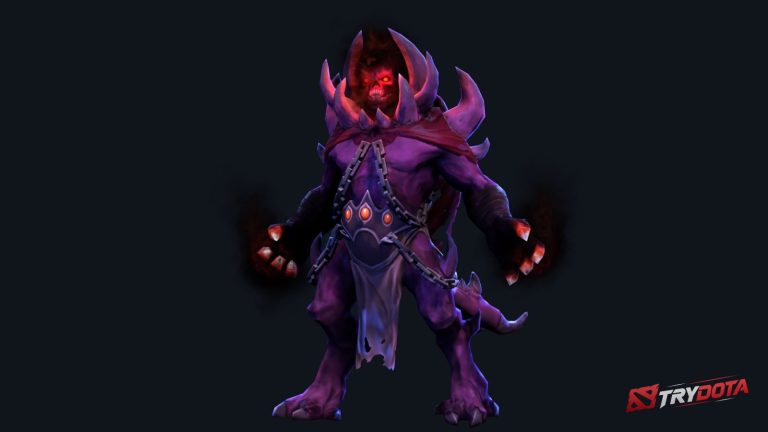
Abaddon is back in the spotlight because of 7.42a: the hero got several changes at once, and they make it pretty clear that the developers slowed down his pressure in long fights a bit. At the same time, OpenDota data still shows him looking very strong in both pubs and on the pro scene. As a player who likes heroes with unusual value for the team, I find the balance between defense, tempo, and annoying pressure through mist and shields especially interesting here.
Role and abilities
Abaddon is a versatile melee hero with a difficulty rating of 1 out of 3. Officially, he is described as a character who protects allies or himself, and I think that’s a very accurate description: almost everything about him is built around surviving damage, extending fights, and making sure enemies can’t just finish off a target in peace.
- Mist Coil — heals an ally and speeds them up, or damages and slows an enemy, at the cost of his own health.
- Aphotic Shield — grants an ally a barrier that absorbs all types of damage and dispels the target when applied; when the shield expires or breaks, it explodes and damages nearby enemies.
- Curse of Avernus — the hero’s attacks apply a slow and damage over time, and also speed up subsequent attacks against the target.
- Withering Mist — an innate passive that does not trigger from item damage.
- Borrowed Time — removes negative effects and, for a few seconds, turns incoming damage into healing.
From the feel of his kit, Abaddon remains a very team-oriented hero: he does not so much create the moment himself as extend his team’s tempo and punish anyone who spends too long hitting the same target. I think that’s exactly why he keeps getting touched in patches — he’s just too unpleasant in fights where quickly breaking someone’s focus matters.
Changes in the latest patches
The fresh 7.42a changes look like a targeted nerf to the part of his kit that made him most annoying to play against.
- 7.42a: the maximum health restoration reduction from Withering Mist was lowered from 40% + 1% per level to 35% + 1% per level.
- 7.42a: Aphotic Shield cooldown increased from 12/10/8/6 to 13/11/9/7 seconds.
- 7.42a: the level 10 talent for bonus damage per second on Curse of Avernus was reduced from 25 to 20.
If you zoom out and look at 7.42 as a whole, the hero was noticeably reworked along several axes at once. And here it becomes clear that the developers did not just trim numbers — they changed the logic of some abilities.
- 7.42: Withering Mist no longer depends on a specific HP threshold on the victim and now always reduces health restoration, with the effect getting stronger at low HP.
- 7.42: Withering Mist now only triggers from damage dealt by attacks and abilities.
- 7.42: the maximum health restoration reduction on Withering Mist was increased from 29.5% + 0.5% per hero level to 40% + 1% per hero level.
- 7.42: the self-damage from Mist Coil now counts as health expenditure; the value itself did not change.
- 7.42: Mist Coil now also slows or speeds up enemies and allies by 60% for 0.7/0.8/0.9/1 second.
- 7.42: Mist Coil received an upgrade from Aghanim’s Scepter and now hits all units in a 400 radius around the target, while the hero additionally makes an attack against each affected enemy for 100% damage and 80% item effectiveness.
- 7.42: Curse of Avernus now lasts 3 seconds instead of 2, while its damage per second was reduced from 15/25/35/45 to 12/20/28/36.
- 7.42: the attack speed bonus from Curse of Avernus changed from 10/20/30/40 to 15/20/25/30, and it was also increased for the owner.
- 7.42: the Aghanim’s Scepter upgrade was removed from Borrowed Time.
- 7.42: the level 10 talent for Aphotic Shield was replaced with a bonus to Mist Coil cast range.
- 7.42: the level 15 talent for Mist Coil was replaced with a boost to Withering Mist.
- 7.42: the level 20 talent for the health cost on Borrowed Time was replaced with +2 seconds duration.
- 7.42: the level 25 talent for Mist Coil area of effect was replaced with 2 charges of Aphotic Shield.
- 7.42: the level 25 talent for attack speed from Curse of Avernus was reduced from 65 to 50.
Overall, it looks like the hero was shifted a little more toward long-term tempo control and team support, rather than easy resource trading. I think that’s a healthy direction: Abaddon is at his best when he annoys opponents not with one big effect, but with a set of small, sticky advantages.
Statistics
According to OpenDota over the last 7 days, Abaddon played 470,556 games in public matches and has a 55.0% win rate. That’s 4th out of 127 heroes by win rate and 20th by number of games. For me, those numbers matter more than any talk about a hero “feeling strong”: if a hero stays near the top of the table over that many matches, it means he has not just a nice set of buttons, but very real practical value.
- Herald — 55.4%
- Guardian — 54.6%
- Crusader — 55.1%
- Archon — 55.8%
- Legend — 55.2%
- Ancient — 55.1%
- Divine — 53.9%
The rank breakdown is pretty even, and that’s a good sign: the hero does not look like one that only works in a single bracket of the ladder. Divine has the lowest win rate, but even there he is still above 53%. In my view, this is exactly the kind of hero whose strength does not come down to one specific mechanic or one good build.
In pro matches, OpenDota shows 21 picks, 13 wins, and 28 bans. In practical terms, that means Abaddon clearly has not fallen off teams’ radar, so he still has something to offer in a more structured game.
Items and matchups
Item-wise in pro matches, the picture is also interesting: Abaddon can start out as a fairly standard support or a tanky all-rounder, then shift quite sharply toward tempo, damage, or useful utility. I would pay attention not to one “ideal” build, but to how items support his role in a specific game.
- Starting: Iron Branch, Tango, Circlet, Magic Stick, Quelling Blade, Blood Grenade.
- Early game: Boots of Speed, Chainmail, Phase Boots, Null Talisman, Arcane Boots, Ogre Axe.
- Mid game: Blade of Alacrity, Sacred Relic, Radiance, Talisman of Evasion, Diadem, Yasha.
- Late game: Blink Dagger, Orchid Malevolence, Bloodthorn, Skull Basher, Aghanim’s Scepter, Soul Booster.
What I find especially interesting here are the more aggressive late-game items: Orchid Malevolence, Bloodthorn, Skull Basher. That is not the kind of loadout you would normally expect from a “pure” defender, and that’s exactly why Abaddon is so easy to misread. He does not have to be just shields and healing; by the numbers, he can also become a very annoying initiator or chaser.
The pro-matchup picture is not entirely linear either. Abaddon performs best against Legion Commander, Dazzle, and Doom, and struggles more against Kunkka, Undying, and Treant Protector. I think that underlines how dependent he is on the shape of the fight: against some heroes he survives the key moment and turns the trade, while against others it is harder for him to force the kind of long fight he wants.
Conclusion
Right now, Abaddon looks like a hero who got trimmed a little, but was not pushed out of the meta or even anywhere close to obscurity. 7.42a nerfed his most annoying sides — Withering Mist, Aphotic Shield cooldown, and the early Curse of Avernus talent — but the overall stats are still very strong. To me, this is the kind of hero that stays valuable not because of one broken element, but because of a set of small decisions that work well in team play. I’ll be watching to see whether he holds these numbers: if the win rate does not drop, then the changes were either too mild or simply missed his core.
Source: official Dota 2 and OpenDota data.
Discuss on the forum (no replies yet — be the first)

Be the first to discuss this…