
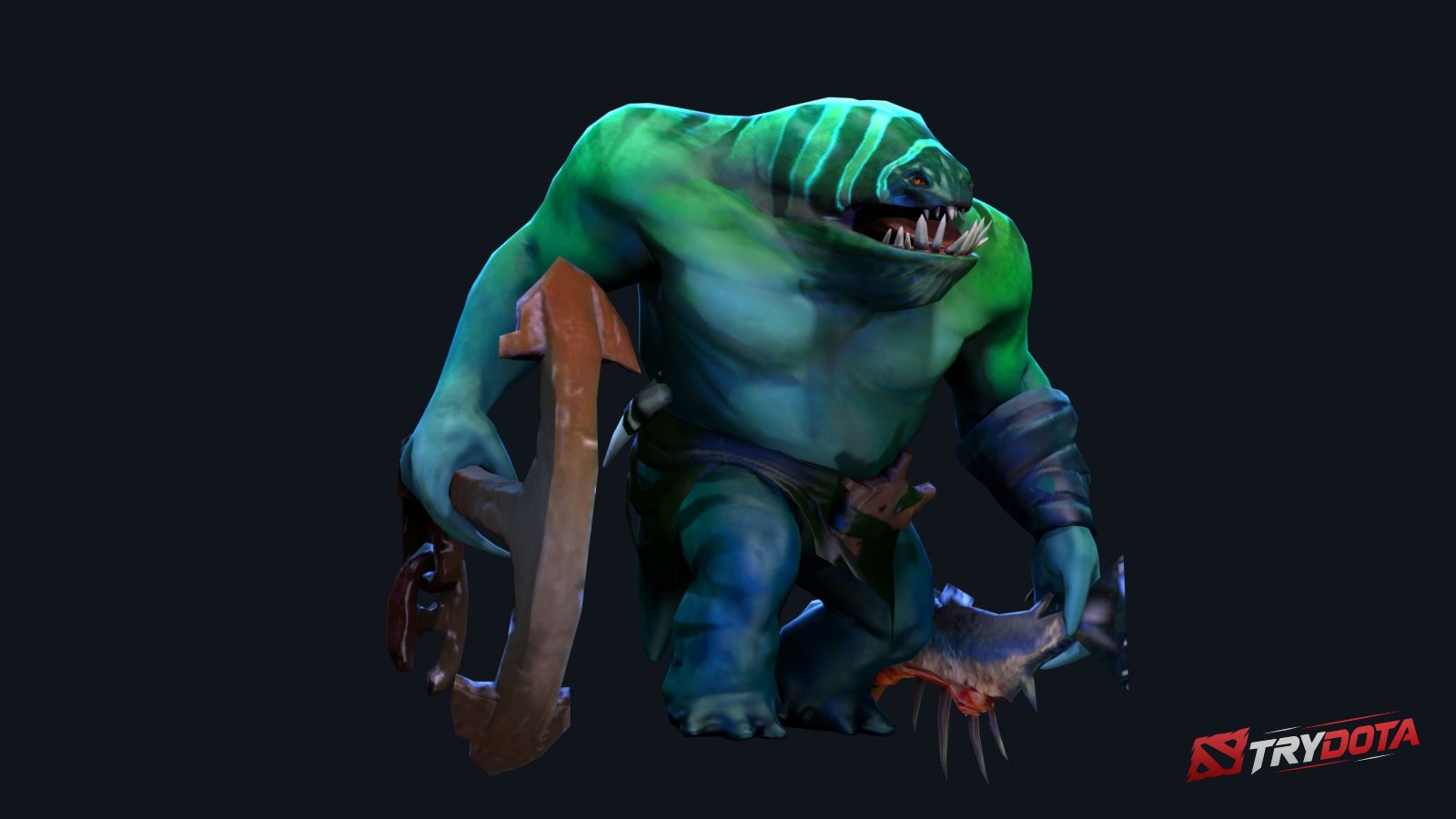
Hello! Today I’m looking at Tidehunter again — and the reason is pretty clear: the hero has already gone through several changes in 7.41, and in 7.41f these kinds of heroes are always the most interesting, because it’s easier to see where his power has shifted and how well he’s actually holding up in the current game.
Role and abilities
Tidehunter is an Strength hero, melee, with simple complexity and a very straightforward set of roles: he can be a durable frontliner, an initiator, and a disabler, and on paper he can also deal a bit of damage as a Nuker. From the way he’s described and from his kit, he still feels like the same hero who doesn’t like to rush: he stands with the team, waits for the moment, and starts the fight exactly when it’s most awkward for the opponent.
- Gush — a wave of water that deals damage and slows enemy movement speed and armor. With Aghanim’s Scepter, the ability becomes point-targeted, has a shorter cooldown, and passes through all enemies in its path.
- Kraken Shell — makes the hero noticeably tankier against physical attack damage and removes negative effects once incoming damage reaches a certain threshold. This is a strong dispel.
- Anchor Smash — a swing of the anchor at nearby enemies that deals area damage and reduces their attack damage. The ability has an important interaction with radius and attack range, so in practice it feels better once Tidehunter can comfortably force melee engagements.
- Dead in the Water — the Aghanim’s Shard ability, which chains a heavy anchor to an enemy hero and roots them.
- Ravage — the iconic ult that shakes the ground and sends tentacles outward, dealing damage and stunning all nearby enemies.
- Leviathan’s Catch — the innate ability: enemy heroes killed by the owner, or those who die under the effect of his debuffs, leave behind a fish, and eating it grants bonuses to health, attack range, and damage block. Every even level also consumes one fish.
I think Leviathan’s Catch, and the kit built around it, is what currently defines the hero in the patch the most. Tidehunter is no longer just “the tanky hero with Ravage,” and now he has an extra internal motivation not only to survive the fight, but also to turn successful kills into constant small upgrades.
Changes in the latest patches
Going from newest to oldest, you can see that the developers didn’t break the hero radically, but rather trimmed the most convenient parts and slightly adjusted his growth pace.
- 7.41c — base mana regeneration reduced by 0.5. It’s a small but unpleasant change for a hero who likes to use his abilities more than once per game phase.
- 7.41b — base Strength reduced from 26 to 25; damage at level 1 reduced from 51–57 to 50–56; Leviathan’s Catch now grants a fish only on even levels; level 15 talent for Gush bonus damage reduced from 100 to 90; level 25 talent empowering Anchor Smash now deals only 50% damage to buildings.
- 7.41a — the travel distance of the spawned fish reduced from 400 to 200.
- 7.41 — Strength gain increased from 3.6 to 3.7; the innate ability Blubber was removed; Leviathan’s Catch was added; Leviathan’s Catch itself was built around a fish that grants +3 health, +2 attack range, and +1 damage block increase; Anchor Smash received a new radius, now calculated as 225 + the hero’s attack range; Kraken Shell began to trigger as a strong dispel after taking a certain amount of damage over 7 seconds; the level 20 Blubber talent was replaced with a combo that triggers Anchor Smash from Kraken Shell’s dispel.
In my opinion, the most important thing here isn’t the individual numbers, but the overall direction. The hero was given a tool for more long-term value, while also having some of his overly straightforward bonuses trimmed back a bit. Because of that, Tidehunter doesn’t look weaker — he looks a little more deliberate: his strength now depends more on how he plays fights, not just on the fact that he has Ravage.
Statistics
According to OpenDota, over the last 7 days Tidehunter took part in 442,536 public games. His win rate is 49.1%, which puts him 76th out of 127 heroes by win rate, and he ranks 30th by number of games. For a hero with such a simple, clear role, that looks fairly average: there’s no sign of peak popularity based on win rate alone, but it can’t really be called a failure either.
- Herald — 51.4%
- Guardian — 50.0%
- Crusader — 49.8%
- Archon — 49.7%
- Legend — 49.1%
- Ancient — 48.2%
- Divine — 47.6%
That distribution feels especially telling to me: the higher the rank, the more Tidehunter’s win rate slips. He holds up better at lower ranks, while in Ancient and Divine he already starts to dip. On paper, that looks like a hero who is easy to understand and useful in simple scenarios, but in more disciplined games he requires much better timing and a cleaner read on when to initiate.
In professional matches, according to OpenDota for the latest period, Tidehunter was picked 7 times, got 6 wins, and had no bans. That’s a very small sample, so I wouldn’t draw sweeping conclusions from it, but the very fact that he got positive results with that many picks still says the hero hasn’t been written off.
Items and opponents
In pro matches, the item picture is pretty expected: Tidehunter builds for survivability, mobility, and late-game value, rather than trying to play as a fragile initiator.
- Starting items: Gauntlets of Strength, Iron Branch, Tango, Quelling Blade, Magic Stick, Circlet
- Early game: Boots of Speed, Chainmail, Phase Boots, Bracer, Soul Ring, Ring of Health
- Mid game: Blink Dagger, Staff of Wizardry, Ogre Axe, Point Booster, Aghanim’s Shard, Blade of Alacrity
- Late game: Mystic Staff, Aghanim’s Scepter, Shiva’s Guard, Scythe of Vyse, Black King Bar, Reaver
What stands out to me most here is the standard idea: first he builds up basic survivability and mana, then he wants Blink Dagger for a clean jump, and after that he upgrades himself with Aghanim’s Shard, Aghanim’s Scepter, and heavy status/control items.
If you look at opponents in professional matches, Tidehunter feels best against heroes who struggle to survive or play around his big initiation, and worst against those who break the tempo, the zone, or the very structure of the fight.
- Best against: Faceless Void — 46 games, 65.2% win rate; Earthshaker — 37 games, 62.2% win rate; Bounty Hunter — 35 games, 60.0% win rate
- Worst against: Lone Druid — 51 games, 21.6% win rate; Clockwerk — 106 games, 32.1% win rate; Treant Protector — 93 games, 34.4% win rate
I’d especially point out Clockwerk and Treant Protector here: the numbers show Tidehunter struggles noticeably more against them, and that fits his image as a hero who needs space for a proper initiation. When that space gets cut off, he no longer looks nearly as comfortable.
My conclusion
Right now Tidehunter feels to me like a hero who hasn’t lost his identity, but has become less “free” to execute. Patch 7.41 gave him a new innate mechanic and added a bit more scaling over the course of the game, while the follow-up changes neatly trimmed the overly comfortable parts — a little mana, a little Strength, a few bonuses from abilities and talents. In the end, he still looks like a reliable initiator and a tanky frontliner, but no longer like a hero who just presses Ravage and automatically gets everything else.
According to OpenDota, his numbers right now are more on the average side, and at higher ranks they’re even noticeably more modest. So I wouldn’t look at Tidehunter as a hero that needs another buff, but rather as a hero whose team needs to know how to use his initiation window. If that’s there, he’s still extremely annoying. If it isn’t, he quickly becomes just a big hero with an anchor.
Source: official Dota 2 and OpenDota data.
Discuss on the forum (2 replies)
That Leviathan’s Catch change is actually pretty interesting. The fish bonuses make him feel less like a one-button ult bot and more like a hero that keeps scaling off good fights. I kinda like when a tank gets rewarded for cleaning up instead of just sitting on Ravage cooldown.
в пабе на нем душно как всегда)))
The mana regen nerf is the one I feel the most here. Tide already wants to press stuff early and keep doing it, so even a small hit like that makes the lane and first rotations feel clunkier.
Not if you just play cleaner
Cleaner helps, sure, but the hero still has to spend mana to matter. If the fight drags and you miss the timing, that small regen hit starts showing up fast.
Anchor Smash radius goes brrr
the 25 talent getting toned down on towers is good. tide already had enough of that annoying backdoor-ish pressure when games got messy, so that part feels way healthier now
У меня на нем через Блинк и Шиву заходило
Шива норм, но без ранней инициации это поздно начинает работать. Если команда не жмет карту, герой просто не успевает навязать свой файт.
Шива хороша, но только после Блинка и хотя бы одного слота на ману. Иначе ты вроде жирный, а нажать толком нечего.
Ravage is overrated
no way, one clean Ravage still wins fights
wins fights when the team wakes up, sure. if they don’t, it’s just a big scary animation and everyone walks away 🙂
Рыбка на четных уровнях – странно, но прикольно))